A garage door looks normal right up till the weather transforms violent. After that it turns into one of one of the most important moving parts in the building envelope. In extreme winds, specifically throughout cyclonic conditions, an unsuccessful garage door is hardly ever just a local repair service task. It can change the pressure inside a home, lift cladding, damages ceilings, and send particles through areas that were never indicated to take that type of force.
On the Gold Shore and throughout other cyclone-prone parts of Queensland, this is not an academic threat. It belongs to the design discussion. Garage doors are huge openings in a wall, and if they are not developed, mounted, kept, and serviced to the right criterion, they can be the weak point that lets the climate in. When that occurs, the damage often relocates promptly from the garage to the remainder of the building.
The garage door is not simply a door
A great deal of individuals consider the garage door as a panel that maintains same-day service cars and trucks secure and rainfall off the tools. That is true in fair weather, however in extreme winds the garage door acts even more like an architectural obstacle. It needs to withstand stress from the exterior while staying locked into the framework, with tracks, springs, cable televisions, bolts, and the opener all doing their part.
When the door falls short, the consequences can spread quick. Queensland government support has made this level for several years: garage-door failing can bring about major damages to wall surfaces, ceilings, roofing system cladding, and contents. It can likewise produce hazardous wind-borne debris. That last point issues more than individuals anticipate. Once a door disintegrate or is ripped away, the sheets, panels, areas, and hardware can end up being air-borne hazards.
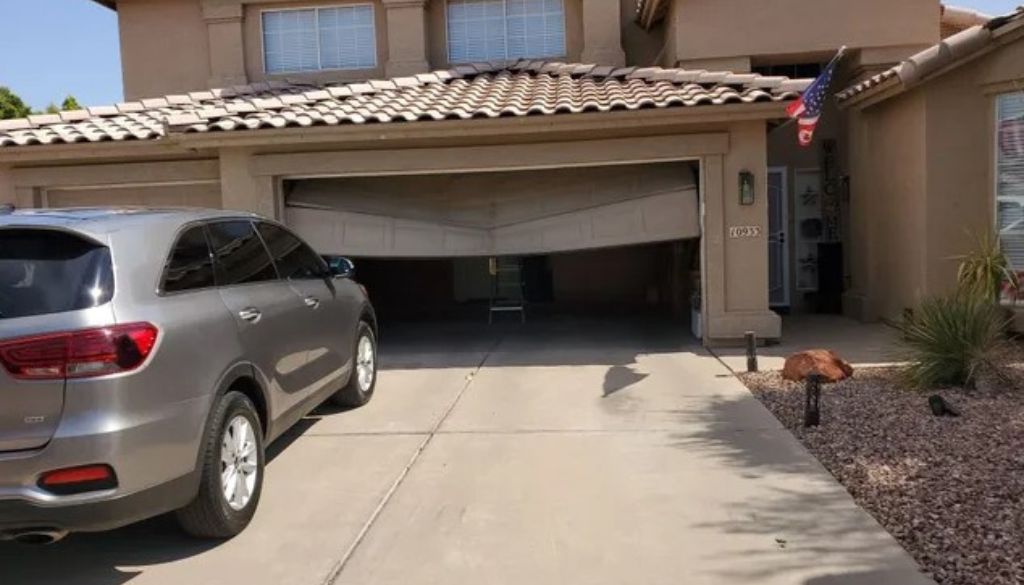
In a serious wind occasion, the door does not require to be totally ruined to trigger problem. Sometimes the failure begins with a solitary point, such as the track coming loose, a springtime shedding tension, or an area bending sufficient that the door no longer seals. That tiny failing can allow wind get in the garage, pressurise the space, and drive the next stage of damage.
What actually occurs when winds get under a garage door
The sequence is frequently awful due to the fact that it is mechanical and physical, not gradual. If wind compels its means inside, the garage ends up being a chamber. Pressure constructs. The door can bow, vibrate, or pop out of its guides. If the door is already old, rusty, poorly serviced, or otherwise suited to the wind region, the margin vanishes quickly.
People commonly think of the garage itself taking the complete impact. In technique, the more comprehensive structure is what pays for the failure. Once wind pressure adjustments inside your house, roof components and wall cellular linings are extra susceptible. Ceiling products can droop or fail. Roof cladding can loosen up. Components in the garage, including storage devices and devices, can be harmed by both wind and water intrusion.
There is also an unsafe secondary effect. A busted door can release particles that strikes home windows, neighbouring residential property, or vehicles. In storm problems, that ends up being a safety concern as high as a home problem. I have seen instances where the actual door damage was just the begin, and the expensive component was whatever the wind did after the opening was compromised.
Why compliance matters before the wind arrives
Garage doors in Queensland are not evaluated by guesswork in cyclone-prone areas. The appropriate criterion is AS/NZS 4505, and Queensland Federal government assistance specifies that doors set up in influenced areas considering that 2012 should meet the wind-rated criterion. Older doors may not have sufficient stamina for cyclonic winds, also if they looked penalty for several years in regular weather.
That distinction is necessary. A garage door can work flawlessly on a calm street for a long time and still be a poor fit for severe wind exposure. Conformity is not simply a documentation issue. It is a proxy for whether the door was designed and installed with the neighborhood threat in mind.
This is where garage door standards end up being more than a technical phrase. Standards Australia notes that Australian Specifications are voluntary unless referenced by regulation. Once referenced by regulation or law, they can come to be compulsory. In Queensland, structure needs rest within a structure that includes the National Construction Code, the Queensland Advancement Code, the Structure Act 1975, and the Building Policy 2021. For homeowners and residential or commercial property managers, that suggests the appropriate standard is not something to deal with as optional guidance if the residential property is in a wind-rated area.
A door that was mounted prior to the present demand may still be functional in a day-to-day feeling, but that is not the like appropriating for serious wind. That gap matters most when the weather comes to be extreme.
The age of the door informs just component of the story
Older doors are not instantly risky, but they deserve scrutiny. Some have actually had repair work, electric motor upgrades, or hardware changes for many years. Others have actually just matured into a condition where deterioration, exhaustion, or bad upkeep has actually minimized their efficiency. A door that has seen coastal air, repeated storms, and years of everyday use will certainly not behave like a fresh installation.
This is one factor repair service choices are not constantly uncomplicated. A broken panel or bent track may look like an easy fix, however if the door is already outside its helpful wind-performance envelope, replacement may be the a lot more reasonable option. That is especially real in subjected areas where climate loading is a recurring concern, not a once-in-a-decade event.
In functional terms, a homeowner needs to ask two questions. First, is the door still carrying out as made? Second, also if it is functioning now, is it the right door for the present compliance and danger account of the building? Those are not identical questions.
Repair, replacement, and the point where caution wins
There is a difference in between a fixing that restores operation and a repair that brings back durability. A door can occasionally be made to open up and close again after a problem, but that does not always indicate it awaits serious winds.
This is where commercial garage door repairs and specialist household job share the very same logic. The auto mechanic needs to look past the noticeable mistake. Springs, wires, rollers, tracks, bolts, hinges, and electric motor elements all issue. If the failure was brought on by impact, rust, water ingress, or repeated pressure, the damages can prolong beyond what shows up at a glance.
A great service technician will also consider whether the existing door kind is ideal. The Gold Shore market frequently contrasts roller, sectional, and tilt doors, and each has its very own strengths and trade-offs. Roller doors can be compact and useful, sectional doors can use a more refined fit and far better insulation alternatives, and tilt doors have their own operating attributes. However none of those groups is immune to wind efficiency problems. The essential inquiry is not the style alone, it is whether the set up item is ranked, maintained, and appropriate for the location.
If a door has currently fallen short in wind, replacement can be the cleaner solution, especially if there is corrosion, duplicated service background, or out-of-date equipment. Repair may buy time, but it is not always the very best risk decision.
The surprise function of maintenance
An unusual variety of garage door failures are not significant at first. They start quietly. A springtime loses performance. A cord tears. A track wanders out of positioning. The opener starts to pressure. The door still works, so the issue gets ignored.
Regular professional maintenance is among the garage door repairs near me prices most basic ways to decrease that risk. Gliderol's maintenance assistance states panel doors ought to be oiled every 3 to 6 months and serviced every 2 years, with more frequent focus for seaside residential or commercial properties. That is a useful suggestion, not marketing fluff. Salt air, moisture, and day-to-day wear reduce the life of moving parts. On the shore, rust avoidance is not optional home cleaning, it becomes part of maintaining the door usable.
Service periods likewise matter for warranty protection. Gliderol notes that failure to follow authorised maintenance intervals might influence warranty security, specifically for motorised elements. B&D similarly specifies that some household garage doors and openers purchased with each other can carry a 10-year Overall Confidence Warranty, but only if the system is serviced within the first one year and after that at least every 2 years.
That informs you something essential about modern garage-door systems. Producers anticipate maintenance. They construct it into the item life cycle since they recognize springs, motors, remotes, and security devices do not stay trustworthy permanently without attention.
The opener becomes part of the climate tale too
When people think of wind damage, they generally focus on the door leaf itself. The opener matters as well. If the opener separates from the door, or if the door is not appropriately involved, the system might not behave as anticipated under stress and anxiety. B&D's troubleshooting support also notes that some common concerns can be as simple as a low remote battery, yet it stresses that qualified specialists should manage repair work and servicing.
That recommendations appears moderate, but it is audio. A garage door system combines saved energy, heavy moving components, and electric parts. Springs and cords are not locations for casual testing. In serious winds, a marginal opener or weak link can be component of the failure chain. If the door is not properly protected, the most effective electric motor worldwide will not make it wind-rated.
Some more recent openers consist of service indicator lights on picked designs, which works because it gives the owner a signal that the system wants interest. That does not change assessment, however it aids with timing. If the light is warning that service is due, it is much better to deal with that prior to storm period, not after a wind event.
What property owners frequently observe prior to a failure
A garage door normally gives some warning, although not constantly much. The indicators are typically subtle. The door might seem harsher than it made use of to. It may wait halfway. It may relocate unevenly or show up to emphasize one area. In a seaside atmosphere, deterioration around the lower side or hardware can be an early sign that the system requires closer attention.
The functional challenge is that owners get used to these signs. They adapt to a door that is a little slower or a little noisier. That is reasonable, but in a serious wind area, adaptation can come to be complacency. A door does not need to be significant to be hazardous. It only needs to shed adequate strength or alignment that the following major wind occasion finds the weak spot.
The safest approach is to treat any modification in motion, sound, or sealing as worth monitoring. Not every fault means replacement. Some are simple service issues. Yet in a risky location, the evaluation should be made by somebody who understands both the hardware and the conformity context.
Security, insulation, and tornado durability are connected
It is very easy to consider garage doors in different classifications: protection, insulation, appearance, and tornado performance. Actually they overlap. A door that secures well, sits squarely in its tracks, and is effectively kept is generally much better all round. It is less most likely to rattle, much less likely to leak, and much less likely to fail under pressure.
Insulation might not be the first thing people relate to severe winds, however it matters in the bigger picture of structure efficiency. A well-fitted door can aid control heat and minimize drafts, which serves on the coast where climate can swing from damp to warm to stormy. The very same fit that assists thermal performance often aids maintain the system stable under wind loading.
Security issues as well. A door that is currently deteriorated by wear or deterioration can be less complicated to interfere with. After serious climate, there is usually a scramble to safeguard properties, clear access, and examine damages. A door that still runs appropriately makes that process simpler.
Choosing the ideal feedback after a wind event
After a severe wind event, the lure is to concentrate on what shows up. Busted panels, a curved track, a stuck opener, or a door that will not close appropriately all demand interest. Yet the ideal reaction is usually much more gauged than a quick patch.
A complete inspection need to take into consideration the door structure, the equipment, the opener, and the surrounding opening. Damage to the wall surface or framework can be just as essential as damages to the door itself. If the door has been displaced of placement, or if the taking care of factors have been compromised, an aesthetic repair will certainly not resolve the underlying issue.
There are truly 3 questions that matter after the storm.
Is the door risk-free to operate? Is the door still suited to the website's wind requirements? Is fixing sufficient, or has the system reached substitute territory?Those inquiries audio simple, but addressing them effectively takes experience. The least expensive option is not always the ideal one, specifically when the following storm season is already on the calendar.
What owners in cyclone-prone areas need to maintain in mind
Queensland's building structure is constructed around real danger, not abstract concept. That is why the standard issues, why wind-rated installment issues, and why older doors should have a mindful review instead of an assumption of adequacy. In affected locations, doors set up since 2012 are anticipated to meet the wind-rated criterion, which expectation is there for a reason.
For home owners, strata supervisors, and commercial drivers, the functional takeaway is simple. Do not await an extreme wind advising to discover whether the garage door is up to the task. Check the service background, try to find corrosion or movement issues, and make sure the door matches the residential or commercial property's direct exposure. If the building sits in a cyclone-prone part of Queensland, conformity with australian compliance for garage doors is not a box to tick and forget. It is part of keeping the structure intact when the climate turns.
And if a door is old, loud, covered together, or repeatedly fixed, it may be time to quit treating it as a small trouble. A garage door that fails in serious winds can turn a manageable maintenance concern right into a building-wide problem really quickly. That is why the ideal response is generally tranquil, early, and expert, not hurried after the very first storm caution has already gone out.